
Review from: The National Centre for Circus Arts, London; 24th October 2026
London hasn’t had a juggling convention for a while, so I was enthusiastic when Charlie Holland told me about his plans for Thrown Together when I bumped into him a couple of months ago. Juggling Conventions have never been purely about juggling – and I definitely remember feeling intimidated arriving at the European Juggling Convention, just outside Rotterdam in 2001, barely able to juggle more than 3 balls – so it was nice to read that Thrown Together has chosen some more inclusive words, calling itself London’s Juggling and Flow Arts Festival.
Arriving at the National Centre for Circus Arts on Saturday morning, having not yet had my first coffee and, perhaps more importantly, not juggled very much at all for a few years – therefore not sure if I would enjoy a day focussed on it, or just be frustrated by my several years lack of practise – I was very happy to bump into some familiar faces. Cormac Mohally, and Noelle Ní Riagáin – who I know from Circus Factory in Cork, Ireland, and who now run Pitch’d Productions – arrived just ahead of me; and, having walked through the reception area, collected some info, spent a few minutes looking at Charlie’s great collection of historical circus posters, and chatting with Nathan at the Oddballs stall about some of his new props, we drank some good coffee and got into a great conversation, sharing a bit of gossip, and talking through different perspectives on Ireland’s new Basic Income for the Arts scheme. It was really interesting as an English artist having witnessed the effect of fifteen years of Arts Council England funding cuts, to hear Cormac’s frustrations at the way the BIA scheme is being administered and the resulting two-tier outcome, when all I had been able to see from this side of the water was the greener grass of the Emerald Isle!
The conversation was cut short by Charlie announcing the start of Turbula…
Cécile Poncet, a former Circus Space graduate from before the millennium, presented her latest production: Turbula. Walking into the dimly lit Creation Studio, we find a small square stage area, edged with wooden boundaries, and strewn with a variety of different sized oloid forms ranging from small, around 10 cm across to bigger ones around 25 or 30 cm across, all made from a variety of different woods.

She arrives on stage and meets the wooden forms with tenderness and curiosity. Exploring how she might interact with, and manipulate them; how they might relate to herself or each other. She collects them and casts them like dice. There’s no result. The clicking of wood against a quiet watery soundscape and relaxed rhythm of pluck and percussion.
She builds a variety of images and interactions all with focussed attention and slow care. Listening to them like sea shells, they become Nautili. I never quite understood what these objects meant to her, but they certainly meant a lot, rolling through gentle fields of light.
In the exploration and the gathering; bathing, and washing herself with these soft wooden shapes it is almost as though she doesn’t matter in her relationship with them. She was present, but so deeply focused on what she was doing, that somehow it seemed as though she was never quite satisfied with any of it.
Obviously, this is being presented at a juggling and flow arts festival, so all the conventions of those artforms were close by, and at times it felt like she wanted the oloids to behave like balls, but they don’t. Was this a metaphor for hoping things in life will be what you want, when they’re not?
… It’s hard to say, as despite the tender personification she conjured as the largest oloid became a mother to a smaller one, and she then took care of them both, I found myself frustrated at a lack of communication. I could see that it all matters, and sometimes felt it too, but I couldn’t understand why, or what it was about. Maybe there was a little too much whimsy for me… Maybe that’s the point.
Turbula is, in Poncet’s words, a collection of stories that make sense to her, and it is for the audience to find their own sense to themselves. But with a strong sense of the fourth wall and, in my opinion, a restricted dynamic range and limited communication, I found it hard to connect with; as a result I’m not sure I found much sense or story for myself. Yes, there were images, ideas and moods, but I was left confused about what, if anything actually happened.
After the show I did a bit of juggling. It was really good being in such a large space juggling with so many other people. I haven’t been in that kind of a situation for quite some time, and it was interesting to remember just how much the space and surroundings affect the type of tricks and movements that one imagines. I ended up throwing a joyful mixture of old tricks and new experiments, and found space to try an idea that I’ve been waiting for the right moment to get started on. There was huge enthusiasm all over NCCA throughout the whole Saturday, and I was really impressed by the way so many of the disciplines I used to practice have really developed much further than I could ever have imagined back then.
The one workshop I attended was the Gandini Patterns workshop. A brief introduction to the work Sean Gandini and Kati Ylä-Hokkala have been doing for the last 30 years. It’s always a pleasure to see that a couple of Europe’s most prolific and influential circus artists can still show up with such joyful enthusiasm for the fundamental building blocks of their work. I really enjoyed working through simple concepts and landing all of a sudden in the middle of a mind-bending challenge. Among other things, we looked at simple Site Swaps and elaborated them by switching between inward and outward throws, shared what would normally be single person patterns between two, and played with several really enjoyable wrist flourishes and different ways of catching into throwing; and, as professional juggler Myles MacDonald quipped, it was right in-keeping with true juggling workshop style: Friendly… simple… easy… Oh My God I can’t even understand what I’ve just seen let alone do it!
It’s really wonderful to be able to find myself in that kind of naïve situation despite having practised for many years, trained with great teachers and performed all over the world. It reminded me of the joy of discovery when you step away from the knowledge you’re certain of and into your own vulnerability.
After the workshop I found myself chatting with Ania Gianattasio, a professional aerialist and one of the teachers at the NCCA, and rediscovering just how useful and enabling the techniques I learnt from the late, great Yuriy Pozdnyakov back in Kiev still are. It was really exciting to see how, with a few words and a couple of minor adjustments, Ania’s 5-ball pattern went from shaky to solid (and it’s always reassuring to step back into one’s certainty after challenging it for a bit).
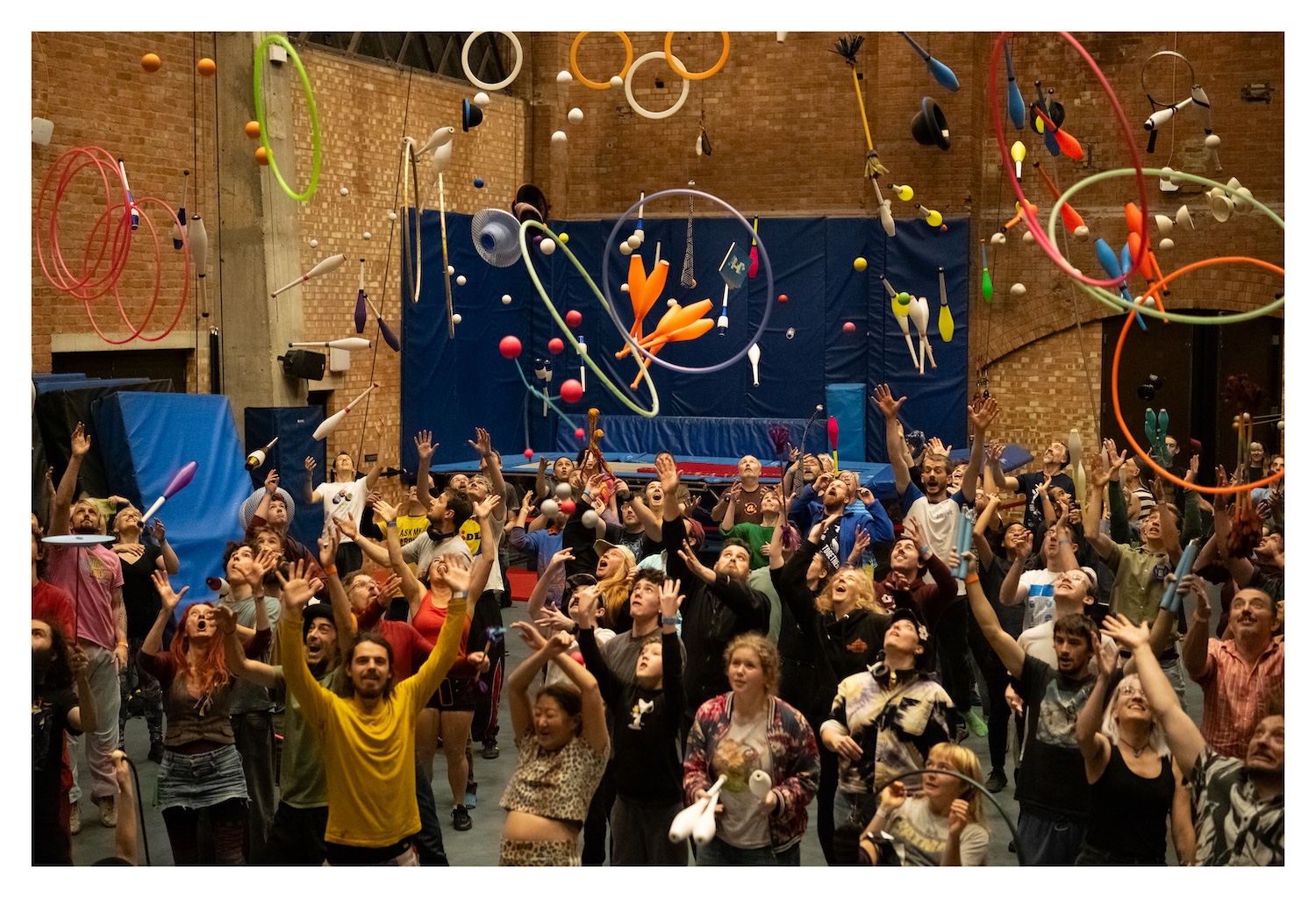
Then, of course, it was time for the end-of-the-day-juggling-convention-classic: the Toss Up, where everyone present (a lot of people!) all throw something in the air all at the same time and someone takes a picture…
I ended my Thrown Together sitting on the floor of the Creation Studio, chatting with an old friend, Joe Hague, while watching physicist/acrobat/world record holding juggler Anne Weber, and another world record holding jugglerTom Whitfield, throw some intricate ring passing, while on the other side of the room Rosalie Amber worked on some beautiful hula hoop body rolls, squeezing the last bit of whimsy out of that wonderful space before the doors shut, and we all got kicked out into the London drizzle.
These kinds of big get-togethers are so important.


