
Review from: Jackson’s Lane, London; 23rd October 2026
Roxana Küwen Arsalan doesn’t so much begin her show as recruit us into it. Over ambient flute music she asks the audience questions, then, after a casual ‘Okay, let’s start’, weaves our answers into an opening letter. It makes us co-authors rather than observers, and it sets the tone for a piece that is generous, funny and quietly pointed.
OMÂ or the privileges of the potato is multilingual and multicultural from its title, which fuses Oma, German for grandmother, with Mâdarjun, its affectionate Farsi counterpart. Küwen Arsalan moves between Persia and Germany, between her two grandmothers, and between comedy and politics, with circus as the thread.
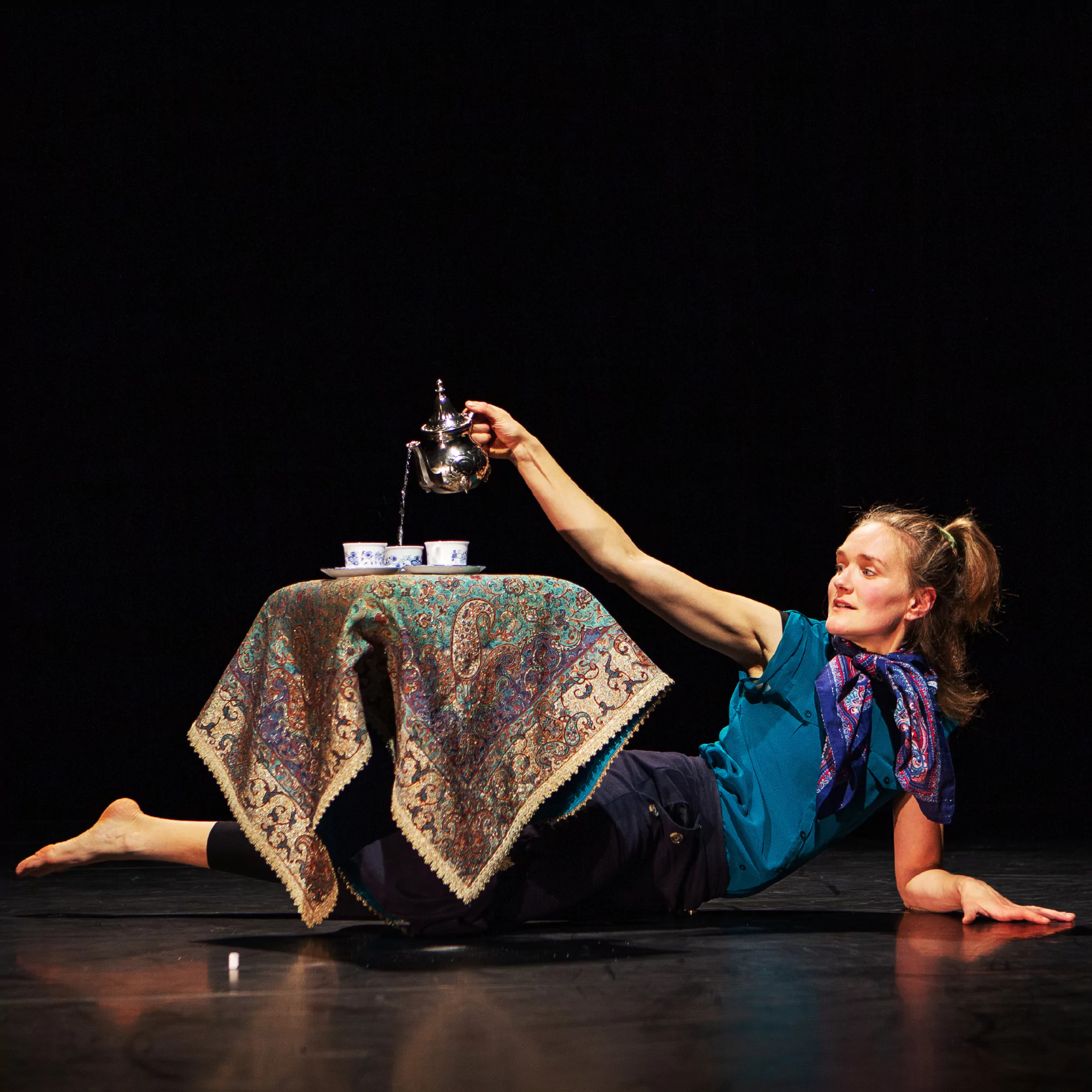
That circus is the show’s strongest asset. Küwen Arsalan is a foot juggler, and objects pass between her feet with a clean control that makes difficulty look effortless. Crucially, the skill never upstages the story. It becomes another way of telling it. The staging is just as disciplined: a single scarf plays Küwen Arsalan and both grandmothers without a costume change, and every prop change feels purposeful. Tea sets that establish Persia turn into circus apparatus, and a teapot catching the stage lights turns a symbol of hospitality into something that glitters.
The tone shifts are handled with care. Comic German interludes arrive just as the mood might turn heavy, and a carrot grated into a soundscape is a delightful piece of invention, because it turns a kitchen chore into an instrument with nothing beyond what is already on stage.
The political material has more bite. A game-show satire pits a potato against a pomegranate. The potato stands for white people, and for whatever society treats as ‘normal’; the pomegranate stands for the ‘exotic’, the ‘other’, the person who is ‘not from here’. By turning these labels into a ridiculous contest, the scene exposes the inequalities built into society and the assumptions we all carry. It is also where the title’s privileges of the potato lands. The most affecting moment is a dance imagining the performance she might have given a decade ago, had women been allowed to dance in Iran, where Küwen Arsalan was living at the time. The physical freedom on stage is shadowed by what that freedom would have cost her.
The audience-interaction scenes work differently. In the first, a spectator plays someone booking her work, a scene drawn from her past, which is slightly confrontational but engaging. The others felt more exposing, for the audience and the character alike. Both carry real risk, and the room feels it.
The closing letter from her grandmothers, and the imagined conversation between two women who never met, let real cultural questions surface without a lecture. Küwen Arsalan’s acknowledgement of the absurd imagery, ‘these are actually feet’, is both funny and earnest, and a knowing nod to the juggling we’ve watched all evening.
This is a show for anyone interested in a global world and in current affairs, and especially for those who feel outside their own communities. It is confronting, but it invites us in rather than pushing us out.
